
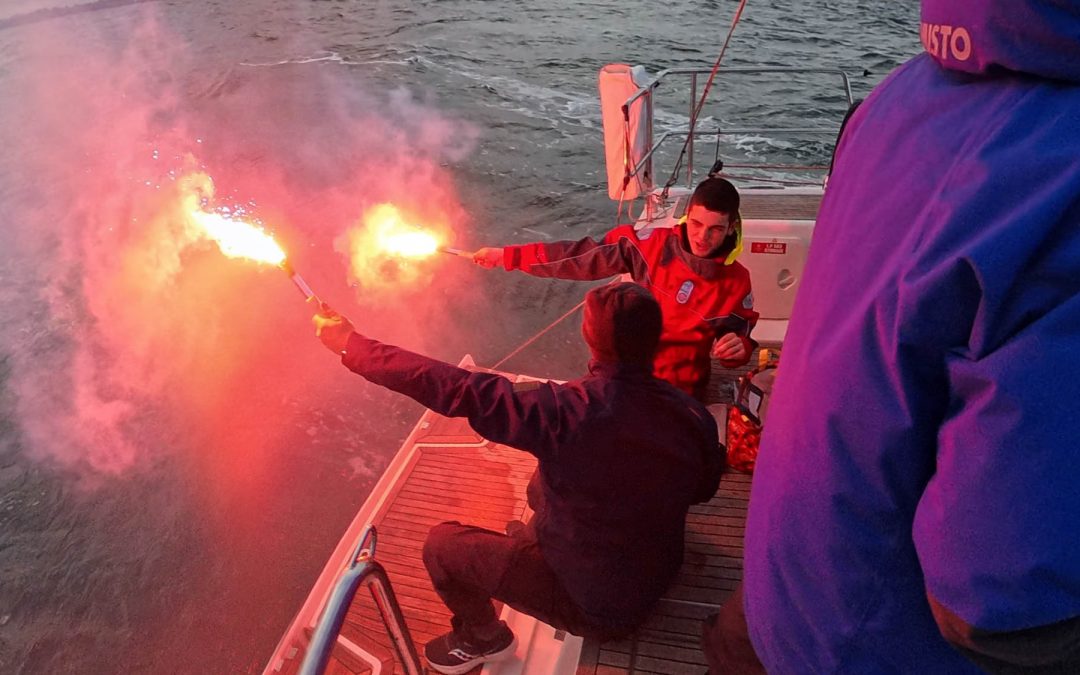
Flare Drills
Prepping Shimmer for Hobart at the ORCV Winter Series
There is nothing quite like a biting, windy June morning on Port Phillip Bay to test both your gear and your nerve. On June 20th, before the starting gun even fired for Race 1 of the 2026 ORCV DYSC Marine Supplies Winter Series, we joined a 25-year-old tradition: the annual live on-water marine distress flare drill off Sandringham Yacht Club.
For our crew aboard Shimmer, Steve Twentyman’s Hanse 505, this wasn’t just a spectacular visual show. With a campaign building toward the upcoming Rolex Sydney to Hobart Yacht Race, every second of practical safety training counts. Firing live flares is highly illegal without a genuine emergency, making this tight 15-minute training window a rare, invaluable opportunity to get comfortable with the heat, smoke, and mechanics of our distress inventory.
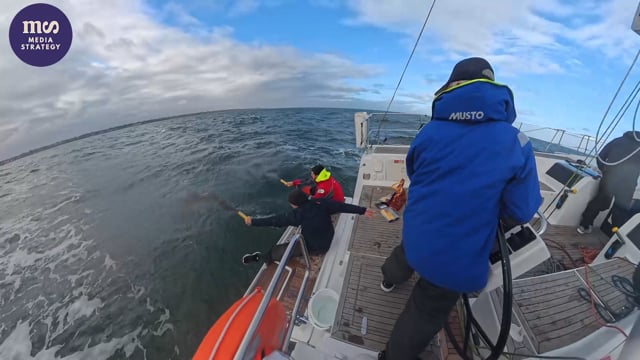
With a strong breeze already whipping up the bay, setting off burning chemicals on a fiberglass deck requires serious caution. To keep the sparks and toxic residue as far away from Shimmer’s hull as possible, Sam and I loaded onto the lowered transom swim platform.
If you watch the video, you’ll see us run through the three primary types of marine flares, each designed for a highly specific phase of search and rescue:
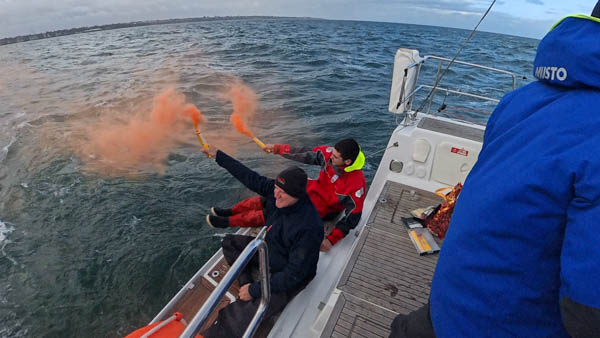
The Day-Glo Indicator: Orange Smoke Flares
The first flares Sam and I lit were the orange smoke canisters.
-
When to use: These are strictly daytime-only distress signals.
-
The purpose: Orange smoke doesn’t give off light, but it creates a massive, dense cloud that is highly visible to searching aircraft or vessels from miles away. It is primarily used to pinpoint a yacht’s exact location once a rescue craft is already in the general area.
The Long-Range Beacon: Rocket Parachute Flares
Next up, we launched the rocket flares.
-
When to use: These are strictly daytime-only distress signals.
-
The purpose: Orange smoke doesn’t give off light, but it creates a massive, dense cloud that is highly visible to searching aircraft or vessels from miles away. It is primarily used to pinpoint a yacht’s exact location once a rescue craft is already in the general area.

The Climax: Handheld Red Flares
The final flares we lit in the video were the classic handheld red flares.
-
When to use: Used during night or day once you can physically see a rescue vessel or aircraft nearby.
-
The purpose: These burn with an incredibly intense red light (around 15,000 candela) for about 60 seconds. Because they get scaldingly hot and drop burning slag—which is why Sam and I were glad to be on the swim platform—they are the ultimate “here we are” signal to guide a rescue boat directly alongside you in poor visibility.

From Flare Practice straight into a Punishing Race
Once the sky cleared of smoke, it was time to race. The Fixed Marks course threw some serious winter pressure at the fleet, resulting in quite a windy, tactical day on the water that caused several retirements across the divisions.
We were pushing Shimmer hard on the first downwind leg when the breeze caught us out, and we sadly blew out our primary spinnaker. It’s the kind of gear failure that tests a crew’s chemistry, but luckily, our Hobart preparation means we’ve been building a versatile, deep sail inventory. We cleaned up the deck, shook off the loss, and successfully flew our heavier A2 asymmetric spinnaker on the following downwind leg to stay right in the hunt.
The hard work paid off. Despite the blown sail and the heavy conditions, Shimmer put on an incredible performance in Division 1, proving exactly what this heavy-built Hanse can do when the pressure arrives:
-
5th on AMS (Division 1)
-
3rd on ORC
-
3rd on PHS
-
5th on Line Honours
Every winter race like this is another crucial layer of familiarity with the boat, the sail wardrobe, and each other. Tearing nylon sucks, but discovering how quickly we can adapt and recover in 25 knots of breeze is exactly the kind of teamwork that will make the difference when we turn Shimmer’s bow south toward Hobart this December.
2026 DYSC Marine Supplies Winter Series - Ocean Racing Club of Victoria
Race 1 (20/06/2026)
| Place | Sail No | Boat Name | Skipper | Fin Tim | Elapsd |
| 1 | SM37 | FARGO | Ari Abrahams | 13:44:50 | 03:09:50 |
| 2 | SM420 | CADIBARRA | Paul Roberts | 13:57:10 | 03:22:10 |
| 3 | M111 | GINAN | Cameron Mckenzie Nigel Jones | 14:06:25 | 03:31:25 |
| 4 | AUS9999 | ASSASSIN | Scott Doughty / Bill Bennett | 14:06:32 | 03:31:32 |
| 5 | SB5005 | SHIMMER | Scott Pimlott Steve Twentyman | 14:11:24 | 03:36:24 |
| 6 | B71 | ANOTHER CHAPTER | Greg Clinnick | 14:13:25 | 03:38:25 |
| 7 | R36 | AGENT J | Peter Layton | 14:17:37 | 03:42:37 |
| 8 | SM5915 | PEGASUS | Andrew Lynch | 14:18:47 | 03:43:47 |
| 9 | S17 | ARCADIA | Peter Davison | 14:19:42 | 03:44:42 |
| 10 | SM3600 | MAVERICK | Tony Hammond | 14:24:36 | 03:49:36 |
| 11 | SM63 | SURPRISE | James Russell | 14:25:36 | 03:50:36 |
| 12 | R935 | VERTIGO | Tim Olding | 14:26:02 | 03:51:02 |
| 13 | R111 | GODZILLA | Andrew Munro | 14:28:37 | 03:53:37 |
| 14 | R138 | ADRENALIN | Peter Little | 14:28:49 | 03:53:49 |
| 15 | B9 | SERIOUS YAHOO | James Heywood | 14:29:03 | 03:54:03 |
| 16 | S16 | ADDICTION | Richard McGarvie | 14:31:07 | 03:56:07 |
| 17 | R367 | CELESTE | Calum Brenan | 14:37:53 | 04:02:53 |
| 18 | H374 | POMPETTE | Ryan Blackstock | 14:38:20 | 04:03:20 |
| 19 | R360 | ORA | Allan Gontar | 14:41:04 | 04:06:04 |
| 20 | R880 | ALIEN | Justin Brenan | 14:43:30 | 04:08:30 |
| 21 | SM1808 | FOGGY DEW | Robert D'Arcy | 14:44:28 | 04:09:28 |
| 22 | H35 | ONYX | Stephen Cheney | 14:45:10 | 04:10:10 |
| 23 | 9211 | VAMONOS | Ross Hines | 14:46:36 | 04:11:36 |
| 24 | H20 | MINNA | Richard Downey | 15:00:21 | 04:25:21 |
| 25 | H808 | REBEL JUST FOR KICKS | Michael Arnold | 15:11:51 | 04:36:51 |
| DNS | S477 | VAGABOND | Andrew McConchie | ||
| RET | R6155 | FASTER FORWARD | Matt Fahey | ||
| RET | SM226 | BLUEPRINT | John Bearsley | ||
| RET | SM2626 | NEXT PAGE II | Peter Forbes | ||
| RET | SYD5 | MRV | Damien King |
Blogs

Airlie Beach Race Week 2025
Airlie Beach Race Week tested sail handling, coordination, and timing across long island legs. On Y Knot, managing the bow meant staying ahead of multiple sail changes under shifting trade-wind breezes. The combination of fast offshore conditions, complex courses, and a skilled crew made it an intense and rewarding experience.

Magnetic Island Race Week 2025
YKnot’s performance demanded anticipation, precise sail transitions, and constant awareness on the bow. The warm waters, trade winds, and tight fleet kept everyone alert, while the relaxed island atmosphere ashore highlighted why offshore racing is as much about people and experience as it is speed.

Cartouche
Cartouche – Beneteau First 50 (RBYC)
I’ve sailed regularly aboard Cartouche, a Beneteau First 50 owned by Steven Fahey, across club racing, ORCV events and major regattas. Racing within a family-run team sharpened my big-boat awareness and offshore readiness, while reinforcing consistency, preparation and calm decision-making across varied conditions.

Scarlet Runner
Delivering Scarlet Runner back to Melbourne with owner and skipper Rob Date after the Melbourne–Hobart Westcoaster was a masterclass in offshore seamanship. A demanding Bass Strait crossing shifted the focus from racing to judgement, restraint, and boat care, highlighting the balance between performance and protection that defines successful offshore sailing.

Australian Yachting Championships (IRC)
Racing on Tenacity in the 2025 Australian Yachting Championships tested precision and teamwork on Hobart’s Derwent. Handling halyards and sail changes as mast person, I experienced the split-second decision-making, calm control, and clear communication required to keep a high-performance Mills 41 moving efficiently through shifting river breezes.

Melbourne to Hobart Westcoaster
Sailing down the coast on Rushour during the Melbourne to Hobart Westcoaster was a masterclass in offshore performance. Heavy Bass Strait and Southern Ocean conditions tested endurance, decision-making, and watch management, while the multihull’s record-breaking pace reinforced the importance of disciplined boat handling, smart routing, and protecting both crew and craft over a long, exposed passage.

Belle – IY60
Racing offshore on Belle, a 60-foot IY60, was a high-intensity test of big-boat handling. Loads, sail changes, and manoeuvres demanded precision, anticipation, and clear communication. The ORCV Coastal Sprint format sharpened situational awareness, adaptability, and crew coordination, giving valuable experience in managing a large offshore yacht under pressure while maintaining speed and control.
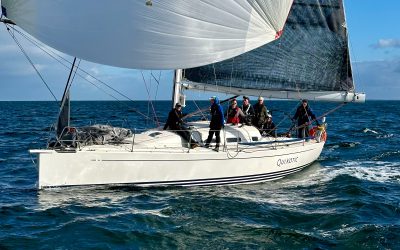
QuiXotic
QuiXotic is a well-sailed X-41, but what stands out most is the crew. Andrew Middleton and the team create a positive, easygoing environment on board, focused on enjoying the racing and sailing well together. It’s a boat where good company and good sailing go hand in hand.
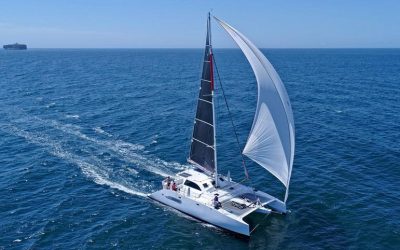
Rushour
On Rushour, I completed the 430nm Southport to Sydney qualifying passage, involved in all aspects of high-performance multihull sailing. From helming in varied conditions to managing asymmetric spinnaker trim and watch rotations, this experience built the discipline and confidence I carried directly into the Melbourne to Hobart Westcoaster.
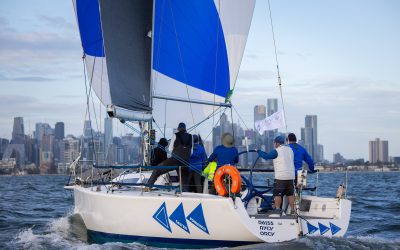
Fast Forward – Sydney 38
Faster Forward isn’t just a respected Sydney 38; for me, it represents the heart of sailing culture. After the Melbourne to Hobart, I was adopted into this tight-knit team, learning that success is built as much through shared dinners and crew camaraderie as it is through miles on the water.
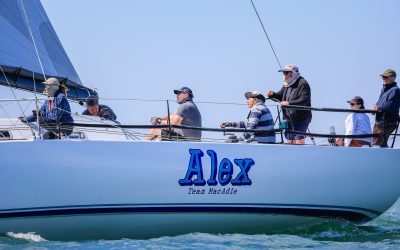
Alex Team Macadie
Alex is a boat with a massive reputation, especially for its legendary double-handed feats. Racing with Jock MacAdie provided a firsthand look at how this Hart 14 has stayed competitive for decades. It’s a platform built on grit and offshore history, where the focus is always on high standards and coastal discipline.
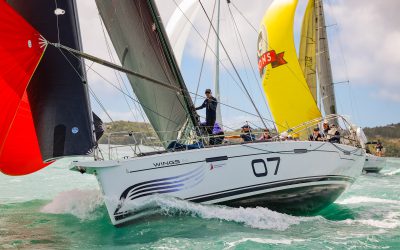
Wings
The 1,100nm delivery of Wings from Hamilton Island to Sydney was a lesson in persistence. Most of the trip was spent punched into 18 to 25-knot headwinds and heavy seas. It was a great chance to get some serious hours on the helm at night and see how offshore routing actually works in the real world.