
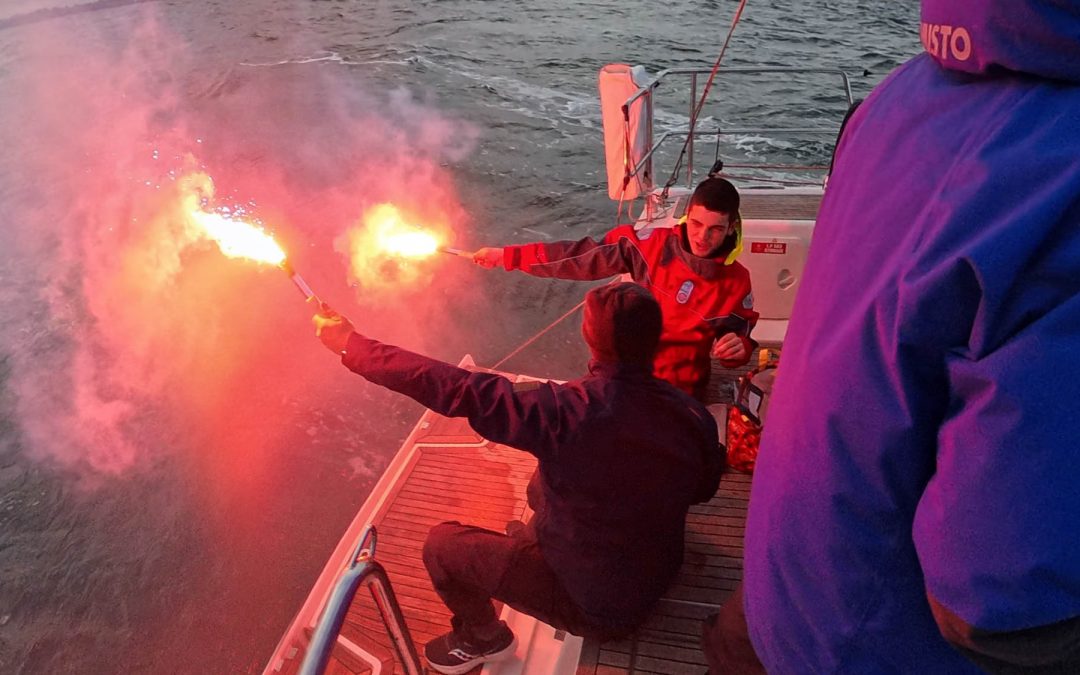
Flare Drills
Prepping Shimmer for Hobart at the ORCV Winter Series
There is nothing quite like a biting, windy June morning on Port Phillip Bay to test both your gear and your nerve. On June 20th, before the starting gun even fired for Race 1 of the 2026 ORCV DYSC Marine Supplies Winter Series, we joined a 25-year-old tradition: the annual live on-water marine distress flare drill off Sandringham Yacht Club.
For our crew aboard Shimmer, Steve Twentyman’s Hanse 505, this wasn’t just a spectacular visual show. With a campaign building toward the upcoming Rolex Sydney to Hobart Yacht Race, every second of practical safety training counts. Firing live flares is highly illegal without a genuine emergency, making this tight 15-minute training window a rare, invaluable opportunity to get comfortable with the heat, smoke, and mechanics of our distress inventory.
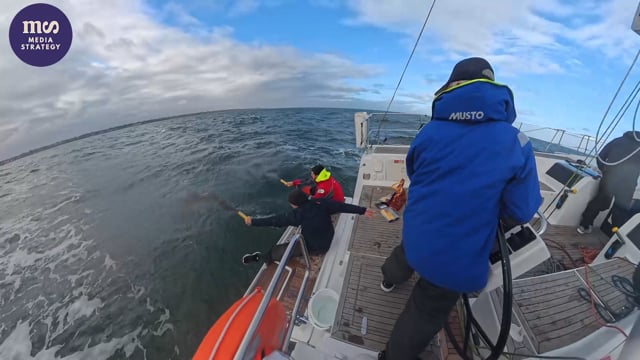
With a strong breeze already whipping up the bay, setting off burning chemicals on a fiberglass deck requires serious caution. To keep the sparks and toxic residue as far away from Shimmer’s hull as possible, Sam and I loaded onto the lowered transom swim platform.
If you watch the video, you’ll see us run through the three primary types of marine flares, each designed for a highly specific phase of search and rescue:
The Day-Glo Indicator: Orange Smoke Flares
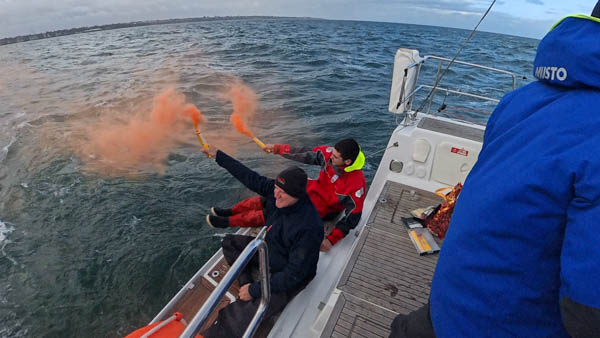
The first flares Sam and I lit were the orange smoke canisters.
-
When to use: These are strictly daytime-only distress signals.
-
The purpose: Orange smoke doesn’t give off light, but it creates a massive, dense cloud that is highly visible to searching aircraft or vessels from miles away. It is primarily used to pinpoint a yacht’s exact location once a rescue craft is already in the general area.
The Long-Range Beacon: Rocket Parachute Flares
Next up, we launched the rocket flares.
-
When to use: These are strictly daytime-only distress signals.
-
The purpose: Orange smoke doesn’t give off light, but it creates a massive, dense cloud that is highly visible to searching aircraft or vessels from miles away. It is primarily used to pinpoint a yacht’s exact location once a rescue craft is already in the general area.

The Climax: Handheld Red Flares
The final flares we lit in the video were the classic handheld red flares.
-
When to use: Used during night or day once you can physically see a rescue vessel or aircraft nearby.
-
The purpose: These burn with an incredibly intense red light (around 15,000 candela) for about 60 seconds. Because they get scaldingly hot and drop burning slag—which is why Sam and I were glad to be on the swim platform—they are the ultimate “here we are” signal to guide a rescue boat directly alongside you in poor visibility.

From Flare Practice straight into a Punishing Race
Once the sky cleared of smoke, it was time to race. The Fixed Marks course threw some serious winter pressure at the fleet, resulting in quite a windy, tactical day on the water that caused several retirements across the divisions.
We were pushing Shimmer hard on the first downwind leg when the breeze caught us out, and we sadly blew out our primary spinnaker. It’s the kind of gear failure that tests a crew’s chemistry, but luckily, our Hobart preparation means we’ve been building a versatile, deep sail inventory. We cleaned up the deck, shook off the loss, and successfully flew our heavier A2 asymmetric spinnaker on the following downwind leg to stay right in the hunt.
The hard work paid off. Despite the blown sail and the heavy conditions, Shimmer put on an incredible performance in Division 1, proving exactly what this heavy-built Hanse can do when the pressure arrives:
-
5th on AMS (Division 1)
-
3rd on ORC
-
3rd on PHS
-
5th on Line Honours
Every winter race like this is another crucial layer of familiarity with the boat, the sail wardrobe, and each other. Tearing nylon sucks, but discovering how quickly we can adapt and recover in 25 knots of breeze is exactly the kind of teamwork that will make the difference when we turn Shimmer’s bow south toward Hobart this December.
2026 DYSC Marine Supplies Winter Series - Ocean Racing Club of Victoria
Race 1 (20/06/2026)
| Place | Sail No | Boat Name | Skipper | Fin Tim | Elapsd |
| 1 | SM37 | FARGO | Ari Abrahams | 13:44:50 | 03:09:50 |
| 2 | SM420 | CADIBARRA | Paul Roberts | 13:57:10 | 03:22:10 |
| 3 | M111 | GINAN | Cameron Mckenzie Nigel Jones | 14:06:25 | 03:31:25 |
| 4 | AUS9999 | ASSASSIN | Scott Doughty / Bill Bennett | 14:06:32 | 03:31:32 |
| 5 | SB5005 | SHIMMER | Scott Pimlott Steve Twentyman | 14:11:24 | 03:36:24 |
| 6 | B71 | ANOTHER CHAPTER | Greg Clinnick | 14:13:25 | 03:38:25 |
| 7 | R36 | AGENT J | Peter Layton | 14:17:37 | 03:42:37 |
| 8 | SM5915 | PEGASUS | Andrew Lynch | 14:18:47 | 03:43:47 |
| 9 | S17 | ARCADIA | Peter Davison | 14:19:42 | 03:44:42 |
| 10 | SM3600 | MAVERICK | Tony Hammond | 14:24:36 | 03:49:36 |
| 11 | SM63 | SURPRISE | James Russell | 14:25:36 | 03:50:36 |
| 12 | R935 | VERTIGO | Tim Olding | 14:26:02 | 03:51:02 |
| 13 | R111 | GODZILLA | Andrew Munro | 14:28:37 | 03:53:37 |
| 14 | R138 | ADRENALIN | Peter Little | 14:28:49 | 03:53:49 |
| 15 | B9 | SERIOUS YAHOO | James Heywood | 14:29:03 | 03:54:03 |
| 16 | S16 | ADDICTION | Richard McGarvie | 14:31:07 | 03:56:07 |
| 17 | R367 | CELESTE | Calum Brenan | 14:37:53 | 04:02:53 |
| 18 | H374 | POMPETTE | Ryan Blackstock | 14:38:20 | 04:03:20 |
| 19 | R360 | ORA | Allan Gontar | 14:41:04 | 04:06:04 |
| 20 | R880 | ALIEN | Justin Brenan | 14:43:30 | 04:08:30 |
| 21 | SM1808 | FOGGY DEW | Robert D'Arcy | 14:44:28 | 04:09:28 |
| 22 | H35 | ONYX | Stephen Cheney | 14:45:10 | 04:10:10 |
| 23 | 9211 | VAMONOS | Ross Hines | 14:46:36 | 04:11:36 |
| 24 | H20 | MINNA | Richard Downey | 15:00:21 | 04:25:21 |
| 25 | H808 | REBEL JUST FOR KICKS | Michael Arnold | 15:11:51 | 04:36:51 |
| DNS | S477 | VAGABOND | Andrew McConchie | ||
| RET | R6155 | FASTER FORWARD | Matt Fahey | ||
| RET | SM226 | BLUEPRINT | John Bearsley | ||
| RET | SM2626 | NEXT PAGE II | Peter Forbes | ||
| RET | SYD5 | MRV | Damien King |
Blogs

Where it All Began
Salt in the BloodWhy Rosebud Yacht Club is Where it All BeganThey say you never forget your first boat, but for me, it was the club that really stuck. My journey with the water started at six years old. My grandmother had just bought a house in Rosebud, and like...