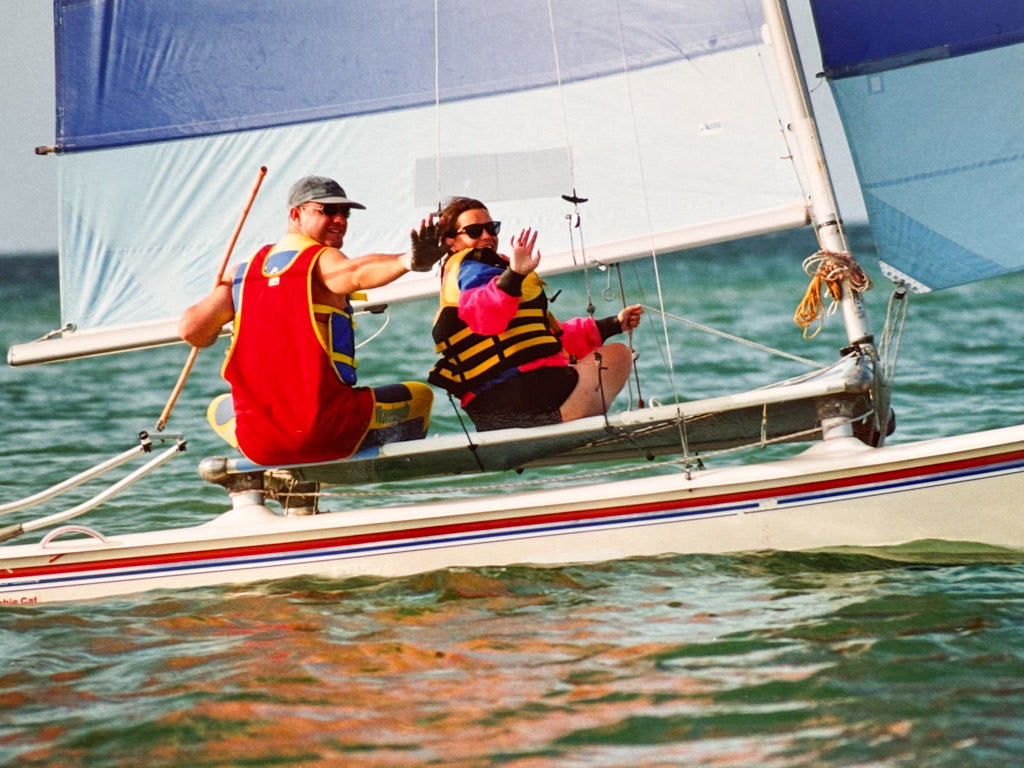
Hobie 16


The Icon That Defined Beach Cat Sailing
As a young sailor, I raced Hobie 16s along the Victorian circuit, competing in regattas on both lakes and the ocean — from Lake Boga, Lake Charm, and Hazelwood Pondage to coastal venues like Torquay and Anglesea. Sailing a Hobie catamaran is a very different experience to monohulls: the speed, acceleration, and responsiveness require constant attention, and learning to use the trapeze effectively is critical for maintaining balance and maximising performance. Managing these elements taught me how to anticipate gusts, work with the apparent wind, and coordinate movements across the boat — skills that carry over to handling high-performance boats in other classes.
The Hobie 16 is one of the most iconic beach catamarans ever built, introduced in 1970 and now sailed in over 100 countries worldwide. Measuring 16 feet 7 inches (5.05m), it features asymmetrical “banana” hulls for lift without daggerboards, a dual-trapeze rig, and is capable of speeds exceeding 20 knots. Designed for 1–4 crew, the Hobie 16 became the cornerstone of competitive catamaran sailing, with tightly regulated one-design rules ensuring skill rather than equipment dominates performance. The class has produced generations of sailors who have gone on to excel in offshore racing, Olympic disciplines, and professional sailing careers, thanks to its combination of high-performance handling, tactical demands, and accessibility.